
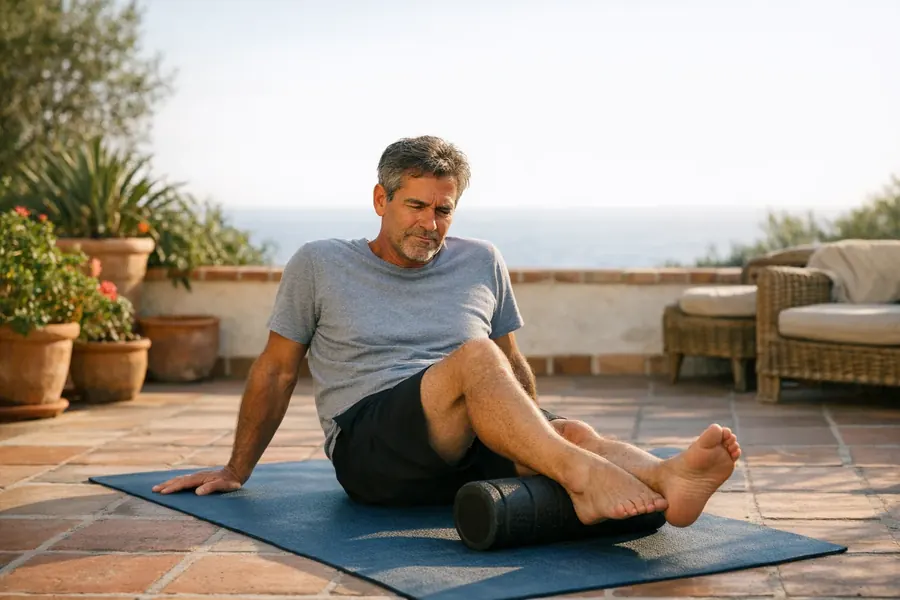
In 30 seconds
- After training, foam rolling reduced perceived muscle pain by 6% on average in a meta-analysis of 21 studies.
- In one trial, 20 minutes of rolling straight after, at 24 and at 48 hours eased muscle soreness and limited the drop in performance.
- Before training, it clearly improves mobility in 26 trials, with no relevant loss of strength or jump performance.
- The approach used in the studies: 1-3 sets of 30-120 seconds per muscle, at whatever pressure feels comfortable.
The foam roller has become a recovery classic. The studies say that it eases muscle pain after training and that, beforehand, it improves mobility without taking away strength. Here is how much, how to use it and what it does not do.
What the roller does
For years it was said that the roller “releases fascia”. Researchers do not see it that way: there is not enough evidence that it releases the tissue that wraps around the muscle 6.
What they suggest are mainly nervous system effects 6:
- Greater stretch tolerance: you become less sensitive to discomfort and can go further.
- Relaxation: the pressure stimulates receptors that can calm nervous system activity.
- Less reflex tension: rolling massage reduces the excitability of spinal reflexes.
Level of evidence by outcome
| Outcome | Evidence | What the data show |
|---|---|---|
| Immediate mobility | High | Large effect in 26 high-quality trials; similar to that of stretching. |
| Muscle pain after training | Moderate | Less perceived pain in 7 studies; muscle soreness eased at 24 and 48 hours in one trial. |
| Recovery of sprint and strength | Low | A small help: 3.1% for sprint and 3.9% for strength after exercise. |
| Performance when used before training | Moderate | No relevant loss of strength or jump performance; a small improvement in sprint. |
| Performance after weeks of use | No clear effect | No changes in 8 studies lasting 4 to 8 weeks. |
The rating is our own, based on the number of studies, their quality and the consistency of the results.
The key studies
| Study | Type | Sample | Outcome |
|---|---|---|---|
| Wiewelhove et al., 2019 | Meta-analysis | 21 studies, 454 people | After training: 6% less perceived pain and slightly better recovery of sprint and strength. Before: 4% more flexibility. 1 |
| Pearcey et al., 2015 | Crossover trial | 8 active men | After 10 sets of 10 squats, 20 minutes of rolling at 0, 24 and 48 hours: less muscle tenderness and better sprint and power. 2 |
| Wilke et al., 2020 | Meta-analysis | 26 high-quality trials | Large effect on immediate joint range of motion, similar to that of stretching. 3 |
| Konrad et al., 2021 | Meta-analysis | 13 studies | Before training, rolling and stretching gave similar performance; compared with static stretching, slightly better in some conditions. 4 |
| Konrad et al., 2022 | Meta-analysis | 8 studies, 245 people | 4-8 weeks of rolling did not change jump, sprint or strength performance. 5 |
| Behm et al., 2020 | Clinical commentary | Review of the evidence | Approach: 1-3 sets of 30-120 seconds. The gain in mobility may last about 20 minutes. 6 |
After training
What changed with the roller after exercise
After training: less pain
The Wiewelhove meta-analysis brought together 21 studies with 454 people. Seven tested the roller after exercise 1:
- Perceived muscle pain: 6% less, the clearest effect.
- Sprint: recovered 3.1% better.
- Strength: recovered 3.9% better.
- Jump: no difference.
The Pearcey trial looks at it in more detail 2. Eight active men did 10 sets of 10 squats at 60% of their maximum, an effort designed to cause muscle soreness. They then used the roller for 20 minutes straight after finishing, at 24 and at 48 hours: 45 seconds per muscle and leg, with 15 seconds of rest, and then round again.
The result: less tenderness in the quadriceps, with a moderate effect at 24 hours and a large one at 48. It also limited the drop in sprint, power and strength endurance 2. It is a small study, but it points in the same direction as the meta-analysis.
What about massage?
The roller is a form of self-massage. In a meta-analysis of 99 studies, massage was the technique that most reduced muscle soreness and feelings of fatigue, applied straight after exercise or up to 2 hours later 7. That analysis did not include the roller, so it does not allow a direct comparison.
In practice, the roller has one big advantage: you have it to hand every day. We review the other techniques in muscle soreness and muscle damage.
Before training
Mobility without losing strength: the figures
Before training: mobility without losing strength
This is where the evidence is strongest.
- Mobility: in 26 high-quality trials, the roller had a large effect on range of motion, similar to that of stretching 3. The gain may last about 20 minutes 6.
- Flexibility and sprint: 4% more flexibility and 0.7% more sprint speed 1.
- Strength and jump: the changes were minimal. The researchers conclude that the roller does not cause significant losses in performance 6.
Roller or stretching before training? In 13 studies, performance was similar. Compared with static stretching, the roller came out slightly ahead in some conditions: in the quadriceps, in strength tasks or with passes of more than 60 seconds 4.
That is why the authors of the large meta-analysis see it as especially useful as part of a warm-up 1.
The approach in the studies
How to use the roller
How to use it, according to the studies
The approach researchers suggest 6:
- 1-3 sets per muscle, of 30-120 seconds each. With 5 sets or more, the effect was trivial.
- Slow passes, of 2 to 4 seconds in each direction.
- Comfortable pressure: the intensity did not change the gain in mobility.
- After a hard session, you can copy the Pearcey protocol: 45 seconds per muscle on the quadriceps, adductors, hamstrings, iliotibial band and glutes, two rounds 2.
With weeks of use
If you use it every day, do you perform better? In 8 studies with 245 people who used the roller for 4 to 8 weeks, jump, sprint and strength performance did not change 5. Its role is in the session and on recovery days, not in improving your personal bests.
What we do not know yet
- Who it applies to: almost all participants were young, healthy and active. The results may not apply to older people or to rehabilitation 6.
- Direct comparisons: there is a lack of trials pitting the roller against massage or compression.
Recovery as a whole
The roller is one piece among several. Recovery also relies on rest, protein and a sensible progression in your training. We explain it in muscle soreness: why it happens and how to ease it.
Among supplements, BCAAs have been studied quite extensively for muscle soreness. A meta-analysis of 18 trials found less muscle soreness than with placebo at 24, 48, 72 and 96 hours 8.
Frequently asked questions
Does foam rolling get rid of muscle soreness?
It eases it. In a meta-analysis, using it after training reduced perceived muscle pain by 6% on average, and in a trial with sessions at 0, 24 and 48 hours, muscle tenderness improved most at 48 hours.
How long should you foam roll for?
The approach researchers suggest is 1 to 3 sets of 30-120 seconds per muscle, with slow passes of 2 to 4 seconds. The muscle soreness trial used 45 seconds per muscle, two rounds.
Is it better to foam roll before or after training?
It is useful at both times. Before, it improves mobility without any relevant loss of strength. After, it eases muscle pain and helps a little with recovering sprint and strength.
Does foam rolling release fascia?
There is not enough evidence that it releases fascia. Researchers believe it works mainly through the nervous system: it increases stretch tolerance and helps the muscle relax.
Sources
- Wiewelhove T, Döweling A, Schneider C, et al. A meta-analysis of the effects of foam rolling on performance and recovery. Front Physiol. 2019;10:376. View publication
- Pearcey GEP, Bradbury-Squires DJ, Kawamoto JE, Drinkwater EJ, Behm DG, Button DC. Foam rolling for delayed-onset muscle soreness and recovery of dynamic performance measures. J Athl Train. 2015;50(1):5-13. View publication
- Wilke J, Müller AL, Giesche F, Power G, Ahmedi H, Behm DG. Acute effects of foam rolling on range of motion in healthy adults: a systematic review with multilevel meta-analysis. Sports Med. 2020;50(2):387-402. View publication
- Konrad A, Tilp M, Nakamura M. A comparison of the effects of foam rolling and stretching on physical performance: a systematic review and meta-analysis. Front Physiol. 2021;12:720531. View publication
- Konrad A, Nakamura M, Behm DG. The effects of foam rolling training on performance parameters: a systematic review and meta-analysis including controlled and randomized controlled trials. Int J Environ Res Public Health. 2022;19(18):11638. View publication
- Behm DG, Alizadeh S, Hadjizadeh Anvar S, et al. Foam rolling prescription: a clinical commentary. J Strength Cond Res. 2020;34(11):3301-3308. View publication
- Dupuy O, Douzi W, Theurot D, Bosquet L, Dugué B. An evidence-based approach for choosing post-exercise recovery techniques to reduce markers of muscle damage, soreness, fatigue, and inflammation: a systematic review with meta-analysis. Front Physiol. 2018;9:403. View publication
- Salem A, Ben Maaoui K, Jahrami H, et al. Attenuating muscle damage biomarkers and muscle soreness after an exercise-induced muscle damage with branched-chain amino acid (BCAA) supplementation: a systematic review and meta-analysis with meta-regression. Sports Med Open. 2024;10:42. View publication
Information based on published studies. It does not replace the advice of a doctor or registered dietitian. The results describe what was measured in each study, not the properties of any specific product. A varied and balanced diet and a healthy lifestyle are important.
