
In 30 seconds
- In humid air, sweat evaporates less and you cool down less well: at 30 °C, cyclists lasted 68 minutes at 24% humidity and only 46 at 80%.
- At Barcelona airport, August has an average maximum of 28.5 °C and 68% relative humidity; Lleida is hotter, at 32.4 °C, but the air is drier, at 56%.
- In sessions of more than an hour, replace 0.5-0.7 g of sodium per litre and 30-60 g of carbohydrate per hour: in humid conditions you sweat more per minute.
- Ice slurries and very cold drinks may be more useful in humid, still heat than in dry, windy heat.
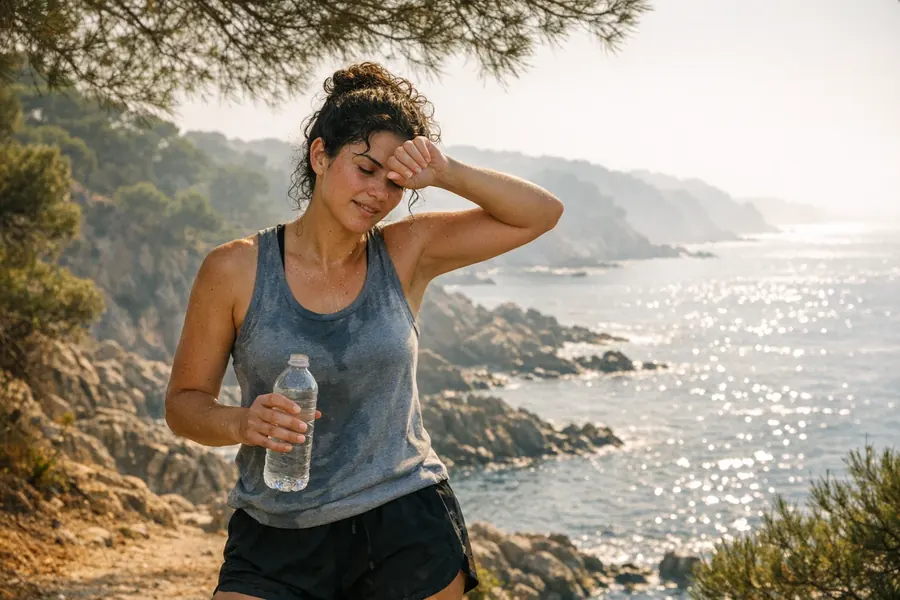
Training in heat and humidity is harder than in dry heat because sweat evaporates less and your body cools less well: at the same temperature, the more humid the air, the less you can last 1. To train well in summer on the Catalan coast, lower the intensity, drink with sodium and cool yourself from the inside with cold drinks or an ice slurry 5 6.
The basics of training in the heat, such as acclimatisation and the signs of heatstroke, are in exercising in hot weather. Here we focus on the humidity of the Mediterranean coast.
Why humidity weighs more than heat
When it is hot, your body cools mainly by evaporating sweat 7. And how much sweat evaporates depends on the difference in humidity between your skin and the air 6. When the air is loaded with moisture, you sweat as much or more, but you cool down less.
A study measured this in eight men cycling at 30 °C to exhaustion, at four humidity levels 1:
- At 24% relative humidity they lasted 68 minutes; at 80%, only 46.
- With more humidity they sweated more per minute: 30 ml at 80%, compared with 22 ml at 24%.
- Body temperature rose faster and their skin ended up hotter.
They were not running out of energy: the authors put it down to accumulated heat 1. And it is not just about performance: cases of heat illness rise as temperature and relative humidity go up 7.
Same heat, more humidity
How long they lasted cycling at 30 °C, by humidity
The Catalan summer: more humid on the coast
In summer, it is not equally hot across Catalonia. Inland, maximum temperatures are higher, but the air is drier. On the coast it is less hot, but the air is more humid and the nights barely cool down 2 3 4:
| Weather station (July / August) | Average maximum | Average minimum | Relative humidity |
|---|---|---|---|
| Barcelona (airport) | 28.0 / 28.5 °C | 19.8 / 20.2 °C | 67 / 68% |
| Girona (airport) | 30.1 / 29.8 °C | 17.1 / 17.0 °C | 59 / 65% |
| Lleida | 33.0 / 32.4 °C | 17.4 / 17.4 °C | 52 / 56% |
Source: AEMET (Spain's state meteorological agency), climate normals 1981-2010 (Lleida, 1983-2010).
In Lleida, the average July maximum reaches 33.0 °C, with 52% humidity; at Barcelona airport, 28.0 °C, but with 67% 2 4. In Girona, where we are from, August combines a 29.8 °C maximum with 65% humidity 3.
The night offers little respite on the coast either: at Barcelona airport, the average August minimum is 20.2 °C 2. Going out first thing spares you the sun and the hottest hours, but not the humidity. That is why a session that feels easy in April can cost you much more in August on the coast.
Look at the humidity, not just the thermometer
At the same temperature, the session can be a different story. In the study, at 30 °C, the WBGT heat index, which takes humidity into account, went from 19.6 °C at 24% humidity to 28.4 °C at 80% 1. And even this index can fall short: the international consensus warns that it may underestimate the risk when sweat cannot evaporate 5.
In practice, before you go out, check the relative humidity and the “feels like” temperature in the forecast. When heat stress is high, the ACSM recommends more breaks and less intensity and duration 7.
How much to drink and how much salt in humid conditions
In the heat it is common to sweat 1-1.5 litres per hour, and some people exceed 2.5 5. In the study, at 80% humidity, sweat reached about 1.8 litres per hour 1.
With those figures, drinking only to thirst can leave you with a deficit of 2-3% of body weight 5. And from 2% onwards, performance starts to drop in heat or humidity 6. In sessions of more than an hour 5:
- Fluid: weigh yourself before and after to know how much you sweat, and drink during the session without exceeding what you lose. You can work it out with the hydration calculator or with your sweat rate.
- Sodium: 0.5-0.7 g per litre of drink.
- Carbohydrate: 30-60 g per hour, and up to 90 g if you go beyond 2.5 hours.
If you notice sweat leaving white marks on your clothes, read how much salt you lose in sweat. And if you run in the mountains, with long stretches between aid stations, the plan is in trail running hydration.
Cool down from the inside: ice and cold drinks
In humid conditions, anything that relies on evaporation cools less. That is why it makes sense to cool yourself from the inside:
- Cool drinks: below 22 °C they taste better and make you drink more. Very cold, below 10 °C, or with ice, they can help you perform in the heat 6.
- Ice slurry: it can cool you more than cold water. The consensus suggests about 1 litre of crushed ice at 4 °C or below 5.
- Timing: cold drinks help mainly when taken before exercise 5.
Here humidity works in your favour: ice slurries and cold drinks can be effective in humid, still heat, and less so in dry, windy heat 6. For humid heat, the consensus also suggests fans and ice vests 5.
And if someone suffers heatstroke, the preferred method is cold-water immersion. In humid conditions, methods that rely on evaporation cool less than contact with cold water 7.
Adapt to the local heat
Acclimatisation is your most useful tool, and it is worth doing in conditions like those of your race or your usual sessions 5. Acclimatising in dry heat also helps in humid heat, but humid heat brings its own adaptations, with hotter skin and more circulatory changes 5.
Ideally, it should last 2 weeks, and 1 week at the very least 5. If you are preparing for a race on the coast in August, train in similar conditions, with shorter, easier sessions in the first few days. The step-by-step guide is in exercising in hot weather and the research in heat and performance.
Your plan for a summer session
| When | What to do |
|---|---|
| Before you go out | Check the relative humidity and the “feels like” temperature, not just the temperature. If they are high, lower the intensity and take more breaks. |
| Just before | A very cold drink, below 10 °C, or an ice slurry, if it agrees with you. |
| During | A cold drink with 0.5-0.7 g of sodium per litre and 30-60 g of carbohydrate per hour, without drinking more than you sweat. |
| To heat up less | Shade, cold water, a fan and an ice vest. |
| After | Replace 100-120% of the weight you have lost, with sodium and food. |
Sources: Racinais et al., 2015; McCubbin et al., 2020; Roberts et al., 2023 (ACSM).
After the session, replacing 100-120% of the weight you have lost is a realistic target 5. You will find the details in the sports hydration guide.
Nitrus for summer on the coast
Nitrus Isotonic provides about 195 mg of sodium, 148 mg of potassium, 15 g of carbohydrate and all 13 vitamins per serving. If you sweat a lot, mix it with 400 ml of water to get more sodium per sip, and have it well chilled or with crushed ice.
Riboflavin (vitamin B2), vitamins B6, B12 and C, niacin, pantothenic acid and folate contribute to the reduction of tiredness and fatigue. A varied and balanced diet and a healthy lifestyle are important. It contains no caffeine, so you can also take it for your late-afternoon sessions. We are a Girona company, with our own formulas made in Spain with IFS Food and BRCGS certification.
Frequently asked questions
Why is it harder to train in humidity?
Because the body cools mainly by evaporating sweat, and in humid air less of it evaporates. In a study at 30 °C, the same cyclists lasted 68 minutes at 24% humidity and 46 at 80%.
At what humidity is it dangerous to train?
There is no single figure: temperature, sun, intensity and your acclimatisation all count. Cases of heat illness rise as temperature and relative humidity go up, so when both are high, lower the intensity and shorten the session.
Which is better for summer training, the coast or inland?
It depends on what you are after. In Lleida, the average July maximum is 33.0 °C with 52% humidity; at Barcelona airport, 28.0 °C with 67%. On the coast it is less hot, but the air is more humid and the nights barely cool down.
What should you drink when training in heat and humidity?
For sessions under an hour, water. Beyond an hour, a cold drink with 0.5-0.7 g of sodium per litre and 30-60 g of carbohydrate per hour. In humid, still heat, an ice slurry before you go out also helps.
Sources
- Maughan RJ, Otani H, Watson P. Influence of relative humidity on prolonged exercise capacity in a warm environment. Eur J Appl Physiol. 2012;112(6):2313-2321. View publication
- Agencia Estatal de Meteorología (AEMET). Valores climatológicos normales: Barcelona Aeropuerto (0076), 1981-2010. View publication
- Agencia Estatal de Meteorología (AEMET). Valores climatológicos normales: Girona Aeropuerto (0367), 1981-2010. View publication
- Agencia Estatal de Meteorología (AEMET). Valores climatológicos normales: Lleida (9771C), 1983-2010. View publication
- Racinais S, Alonso JM, Coutts AJ, et al. Consensus recommendations on training and competing in the heat. Br J Sports Med. 2015;49(18):1164-1173. View publication
- McCubbin AJ, Allanson BA, Caldwell Odgers JN, et al. Sports Dietitians Australia position statement: nutrition for exercise in hot environments. Int J Sport Nutr Exerc Metab. 2020;30(1):83-98. View publication
- Roberts WO, Armstrong LE, Sawka MN, Yeargin SW, Heled Y, O'Connor FG. ACSM expert consensus statement on exertional heat illness: recognition, management, and return to activity. Curr Sports Med Rep. 2023;22(4):134-149. View publication
Information based on published studies. It does not replace the advice of a doctor or registered dietitian. The results describe what was measured in each study, not the properties of any specific product.
