
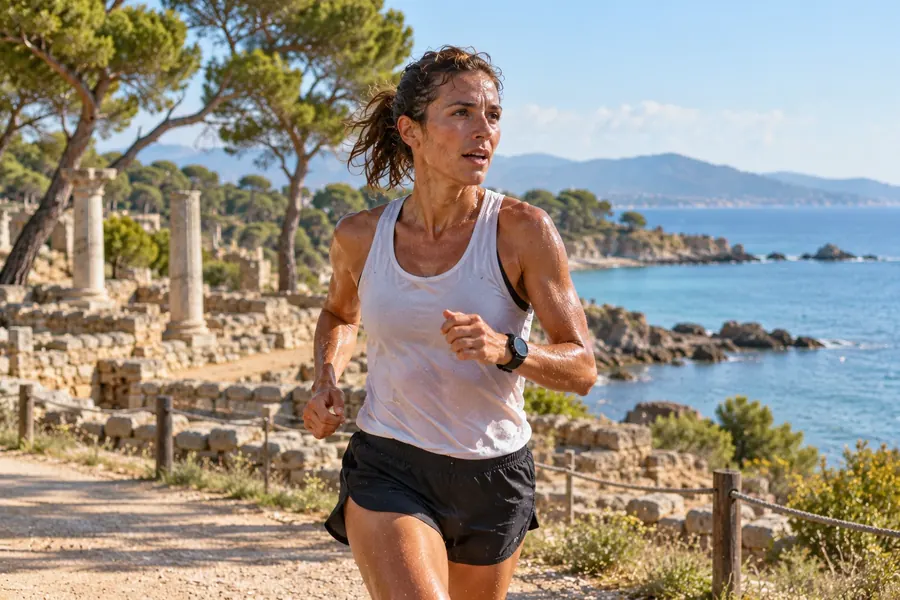
In 30 seconds
- The Empúries Marathon is usually held in April in L'Escala: in 2026 it took place on 19 April, starting at 8.30 am from the Museu d'Arqueologia d'Empúries.
- Girona's Marató Vies Verdes will be held on 25 April 2027 along the Via Verda del Carrilet greenway, with an aid station every 5 km and a 5 h 15 min time limit for the marathon.
- During the race, drink to thirst, with 400-1,100 mg of sodium per litre, and take 30-60 g of carbohydrates per hour, up to 90 g if you are out for more than 2.5-3 hours.
- In the days before, 10-12 g of carbohydrates per kilo per day for 36-48 hours; afterwards, 1.25-1.5 litres for every kilo lost.
The Empúries Marathon (Marató d'Empúries) is usually held in April in L'Escala: in 2026 it took place on 19 April, starting at 8.30 am from the Museu d'Arqueologia d'Empúries 1. To run it, drink to thirst, with 400-1,100 mg of sodium per litre 2, and take 30-60 g of carbohydrates per hour, up to 90 g if you are out for more than 2.5-3 hours 3.
Girona's other spring marathon is the Marató Vies Verdes, which in 2027 will be run on 25 April along the Via Verda del Carrilet greenway 4. Here is what both races are like and how to prepare for them. And if you also ride, you will find the Volta, The Traka and Sea Otter Europe in cycling in Girona.
Girona's two spring marathons
| Empúries Marathon | Marató Vies Verdes, Girona | |
|---|---|---|
| When | Usually in April (27 April 2025 and 19 April 2026) | Sunday 25 April 2027 |
| Where | L'Escala and Sant Martí d'Empúries, starting at the Museu d'Arqueologia d'Empúries | Via Verda del Carrilet greenway, from the mountains to the sea |
| Start | 8.30 am (2026 edition) | 9 am, all distances together |
| Distances | Marathon, half marathon, 10 km and 5 km | 42, 30, 21 and 10 km |
| Terrain | Coastal paths, beaches and monuments | 80% compacted dirt track; -69 m elevation change on the marathon |
| Aid stations | Check them on the race website before each edition | At km 5, 10, 15, 20, 25, 30, 35 and 40 and at the finish |
Sources: Esport3, 2026; Empordà Turisme, 2025; Marató Vies Verdes website and rules.
Empúries Marathon: between ruins and sea
The race starts at the Museu d'Arqueologia d'Empúries and follows coastal paths, beaches and monuments through L'Escala and Sant Martí d'Empúries 1. The same weekend there is a half marathon, a 10 km and a 5 km race 5. In 2025 it was run on 27 April 5, and in 2026 on 19 April 1. The 2027 date has not been published yet: it usually falls in April.
At Girona airport, April has average highs of 18.8 °C and lows of 6.2 °C 6. With an 8.30 am start, you set off in the cool and finish once the day has warmed up: dress for kilometre 30, not for the start line.
Marató Vies Verdes: from the Carrilet to the sea
Girona's Marató Vies Verdes will take place on Sunday 25 April 2027. All distances, 42, 30, 21 and 10 km, start together at 9 am, and the buses to the start leave from the Palau d'Esports i Congressos in Platja d'Aro 4. In 2026, the marathon started in Girona and ran through Cassà de la Selva and Llagostera to Platja d'Aro 1.
The course follows the Via Verda del Carrilet: 80% compacted dirt track, with no stones or narrow trails, and on the marathon an elevation change of -69 m 4. The organisers recommend mixed-terrain shoes and set a 5 h 15 min time limit for the marathon, a pace of 7:30 min/km 4.
There are aid stations at kilometres 5, 10, 15, 20, 25, 30, 35 and 40 and at the finish, with water, soft drinks, isotonic drinks, energy bars, fruit, nuts and sweets 7. If you run at 6 min/km, you reach one every 30 minutes: with 0.4-0.8 litres per hour as a guide 2, that is around 200-400 ml per aid station, if you are thirsty.
From the day before to the finish
Your marathon plan in four steps
Your eating and drinking plan
| When | What to do | Example for 70 kg |
|---|---|---|
| 36-48 hours before | Carbohydrate loading: 10-12 g per kilo per day | 700-840 g of carbohydrates a day |
| 1-4 hours before | Breakfast with 1-4 g of carbohydrates per kilo | 70-280 g of carbohydrates |
| 2-4 hours before | Drink 5-10 ml per kilo | 350-700 ml |
| During the race | To thirst, with 400-1,100 mg of sodium per litre; 30-60 g of carbohydrates per hour, up to 90 g if you are out for more than 2.5-3 hours | 0.4-0.8 L per hour as a guide |
| After | 1.25-1.5 L for every kilo lost | If you have lost 1 kg, 1.25-1.5 L |
Sources: Thomas et al., 2016; Mosler et al., 2020. Adjust your fluid intake to your own sweat rate.
The days before: carbohydrate loading
For races lasting more than 90 minutes, the guideline is 10-12 g of carbohydrates per kilo per day for the 36-48 hours beforehand 3. For 70 kg, that is 700-840 g a day: put pasta, rice, bread, potatoes or fruit on your plate at every meal.
Race morning
Have breakfast with 1-4 g of carbohydrates per kilo 1 to 4 hours before 3, and drink 5-10 ml per kilo in the 2-4 hours beforehand, until your urine is pale yellow 2. At Empúries, with the 8.30 am start, breakfast between 5:30 and 6.30 am gives you 2-3 hours of margin. At the Vies Verdes, the marathon bus leaves at 7.15 am 4: have breakfast before you get on.
During the race
- Carbohydrates: 30-60 g per hour if the race lasts 1-2.5 hours, and up to 90 g if you are out for more than 2.5-3 hours 3. The amounts are in grams per hour, not per kilo of body weight 8.
- Mix of carbohydrates: the more you take per hour, the more it pays to combine different types, such as glucose and fructose 8.
- Fluid and sodium: to thirst, without replacing more than 80% of what you sweat, with 400-1,100 mg of sodium per litre 2.
- Nothing new on race day: your gut can be trained too, so test exactly what you are going to take on your long runs 8.
In a 4-hour marathon, at 60 g per hour, that is 240 g of carbohydrates. Count the grams in each gel and spread them across the aid stations.
Beware of drinking too much
The main cause of exercise-associated hyponatraemia is drinking more fluid than you lose 9. Over the marathon distance, studies find hyponatraemia without symptoms in between 0 and 12-13% of finishers 9. Severe cases show up as headache, vomiting or confusion, and gaining weight during the race means you have drunk too much 9.
Do not drink at every aid station out of obligation. We explain it in drinking too much water: hyponatraemia.
After the finish
Weigh yourself before and after: for every kilo lost, 1.25-1.5 litres over the following hours 3. If you have lost less than 5% of your body weight and are not running again within 24 hours, your usual meals, snacks and water are enough 2. You have the step-by-step in how to rehydrate after training.
With Nitrus Isotonic
We are a Girona company, and these marathons are right on our doorstep. A serving of Nitrus Isotonic is 25 g in 400-500 ml of water: around 195 mg of sodium and 15 g of carbohydrates, with five electrolytes and all 13 vitamins. Riboflavin (vitamin B2), vitamins B6, B12 and C, niacin, pantothenic acid and folate contribute to the reduction of tiredness and fatigue. A varied and balanced diet and a healthy lifestyle are important.
| Preparation | Sodium per serving | Sodium per litre | Carbohydrates per serving | Carbohydrates per litre |
|---|---|---|---|---|
| 25 g in 400 ml | 195 mg | 488 mg | 15.1 g | 37.8 g |
| 25 g in 500 ml | 195 mg | 390 mg | 15.1 g | 30.3 g |
Each 25 g serving contains 0.488 g of salt (about 195 mg of sodium), 148 mg of potassium and 15.13 g of carbohydrates.
Use it on your long runs, to try it out; on race morning, as part of the 5-10 ml per kilo; and as you cross the finish line, to start replacing what you have lost. Work out how much you sweat with the hydration calculator, and you have the full plan in the running nutrition guide. The race hydration planner already has the Empúries Marathon loaded. If you take it often, the Hydration Pack brings together two tubs of Nitrus and BCAAs for €53.90, with free delivery.
Frequently asked questions
When is the Empúries Marathon 2027?
The 2027 date has not been published yet. It is usually held in April: in 2025 it was on 27 April and in 2026 on 19 April, starting at 8.30 am from the Museu d'Arqueologia d'Empúries.
When is the Marató Vies Verdes Girona 2027?
On Sunday 25 April 2027. All four distances, 42, 30, 21 and 10 km, start together at 9 am, and bib collection is at the Palau d'Esports i Congressos in Platja d'Aro.
Where are the aid stations on the Marató Vies Verdes?
At kilometres 5, 10, 15, 20, 25, 30, 35 and 40 and at the finish. You will find water, soft drinks, isotonic drinks, energy bars, fruit and nuts.
How many gels should you take in a marathon?
It depends on the carbohydrates in each gel and on your finishing time. The guide is 30-60 g per hour, and up to 90 g if you are out for more than 2.5-3 hours. In a 4-hour marathon at 60 g per hour, that is 240 g: test it on your long runs.
How much should you drink during a marathon?
Drink to thirst, without replacing more than 80% of what you sweat; as a guide, 0.4-0.8 litres per hour. If you weigh more at the finish than at the start, you have drunk too much.
Sources
- Redacció Esport3. Maratons i curses populars a Catalunya el 2026: dates, llocs i inscripcions. 3Cat, 6 January 2026. View publication
- Mosler S, Braun H, Carlsohn A, et al. Position of the working group sports nutrition of the German Nutrition Society (DGE): fluid replacement in sports. Dtsch Z Sportmed. 2020;71(7-9):178-184. View publication
- Thomas DT, Erdman KA, Burke LM. Position of the Academy of Nutrition and Dietetics, Dietitians of Canada, and the American College of Sports Medicine: nutrition and athletic performance. J Acad Nutr Diet. 2016;116(3):501-528. View publication
- Marató Vies Verdes. Girona, Ruta del Carrilet: programme, distances, elevation and cut-off times for the 2027 edition. View publication
- Empordà Turisme. Empúries Marathon 2025. Empordà events calendar. View publication
- Agencia Estatal de Meteorología (AEMET). Valores climatológicos normales: Girona Aeropuerto, 1981-2010. View publication
- Marató Vies Verdes. Race rules (aid stations, assistance and time limit). View publication
- Jeukendrup AE. A step towards personalized sports nutrition: carbohydrate intake during exercise. Sports Med. 2014;44(Suppl 1):S25-S33. View publication
- Hew-Butler T, Rosner MH, Fowkes-Godek S, et al. Statement of the 3rd International Exercise-Associated Hyponatremia Consensus Development Conference, Carlsbad, California, 2015. Br J Sports Med. 2015;49(22):1432-1446. View publication
Information based on published studies. It does not replace the advice of a doctor or registered dietitian. The results describe what was measured in each study, not the properties of any specific product.
