
In 30 seconds
- In a study with 1,303 athletes, endurance athletes lost an average of 1.28 litres of sweat and about 1,190 mg of sodium per hour.
- The guidelines recommend 400-1,100 mg of sodium per litre of drink from one hour onwards, especially if you sweat more than 1.2 litres per hour and go beyond 2 hours.
- In a trial with 26 triathletes, salt before and during a half ironman was linked to a faster finishing time and more sodium in the blood at the end.
- Sodium slows the fall in blood sodium, but it does not prevent hyponatraemia if you drink too much: the volume you drink is what counts.
Sodium is the mineral you lose most when you sweat and the one that helps you retain the water you drink. The studies agree that replacing it helps you rehydrate and slows the fall in blood sodium; for performance, the results are promising, but still scarce.
Sodium in sweat
How much sodium you lose in sweat
Why sodium matters in sport
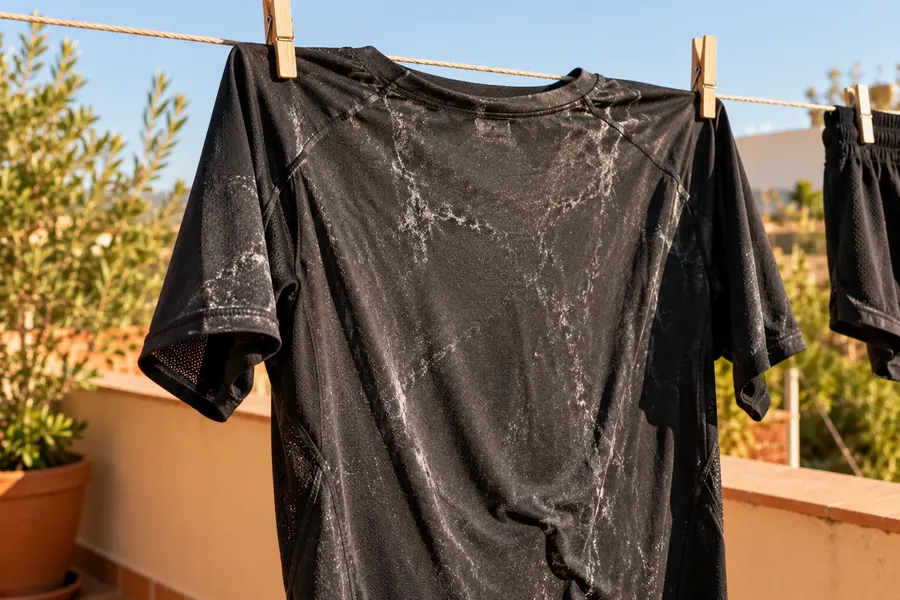
Sweat is mostly salty water. On average it contains about 900 mg of sodium per litre, although it ranges from 175 to 1,512 mg depending on the person 3. In the heat and with intense training, losses can reach 3.5-7 g of sodium a day 3.
Sodium keeps water in the blood. That is why, when you replace it, you retain the fluid you drink better and restore your plasma volume sooner 8.
Level of evidence by outcome
| Outcome | Evidence | What the data show |
|---|---|---|
| Sodium to retain fluid when rehydrating | High | Helps restore plasma volume and reduces what is lost in urine. |
| Sodium during exercise and blood sodium | Moderate | Slows the fall when people drink a lot; the effect depends on the volume drunk. |
| Sodium during exercise and performance | Low | Faster time in a half-ironman trial; no differences in an ironman trial. Large trials are lacking. |
| Sodium preloading before exercising in the heat | Preliminary | Increases plasma volume and helps regulate temperature during steady-paced efforts. |
| Sodium to prevent hyponatraemia | No clear effect | It does not prevent it if people drink too much: the main cause is excess fluid. |
| Sodium and cramps | No clear effect | A systematic review found no evidence linking them. |
The rating is our own, based on the type of studies, their number and the consistency of the results.
The key studies
| Study | Type | Sample | Outcome |
|---|---|---|---|
| Barnes et al., 2019 | Observational study | 1,303 athletes | Average sweat of 0.83 to 1.51 L per hour depending on the sport. In endurance sports, 1.28 L and 51.7 mmol (about 1,190 mg) of sodium per hour. 1 |
| Baker, 2017 | Review | Measurement methods and variability | Whole-body sweat sodium of about 10-70 mmol/L (230-1,610 mg per litre). Less sodium with heat acclimatisation. 2 |
| Del Coso et al., 2016 | Randomised trial | 26 triathletes, half ironman | 113 mmol of sodium (about 2,600 mg) in capsules before and during the race: faster finishing time and more sodium in the blood than with placebo. 4 |
| Hew-Butler et al., 2006 | Randomised trial | 413 triathletes, ironman | About 3.6 g of extra sodium in tablets: the same blood sodium, the same change in weight and the same finishing time as with placebo. 5 |
| Twerenbold et al., 2003 | Crossover trial | 13 women, 4 hours of running drinking 1 L per hour | With 680 mg/L of sodium, blood sodium fell by 2.5 mmol/L; with water, by 6.2. Mild hyponatraemia in 46% compared with 92%. 6 |
| Hoffman and Stuempfle, 2015 | Observational study | 161 km ultramarathon | 6.6% of finishers had hyponatraemia. Drinking too much was the main feature; the sodium from tablets had little influence. 7 |
| Veniamakis et al., 2022 | Systematic review | Endurance and ultra-endurance sports | Most studies find better performance, a smaller fall in blood sodium and more plasma volume when salt intake is matched to sweat losses. 9 |
How much sodium you lose
A lot, and it varies widely from one person to another. In Barnes's study, with 1,303 athletes, the average loss per hour was as follows 1:
| Sport | Sweat per hour | Sodium per hour |
|---|---|---|
| American football | 1.51 L | 1,286 mg |
| Endurance sports | 1.28 L | 1,189 mg |
| Basketball | 0.95 L | 794 mg |
| Football | 0.94 L | 796 mg |
| Baseball | 0.83 L | 626 mg |
Source: Barnes et al., 2019. 1,303 athletes. Sodium converted from mmol to mg (1 mmol = 23 mg).
Baker's review puts whole-body sweat sodium at about 10-70 mmol per litre, that is, between 230 and 1,610 mg 2. Diet and acclimatisation, among other things, play a part: when your body gets used to the heat, your sweat becomes less salty 2.
If you want to estimate your losses, first work out how much you sweat with your sweat rate. We explain how to tell whether your sweat is salty in how much salt you lose in sweat.
Sodium during exercise and performance
There are few trials, and their results do not fully agree:
- Half ironman: in a trial with 26 triathletes, some took capsules with 113 mmol of sodium (about 2,600 mg) before and during the race. They finished sooner than the placebo group. They also ended up with more sodium in their blood and tended to lose less weight 4.
- Ironman: in 413 triathletes, about 3.6 g of extra sodium in tablets did not change blood sodium, weight or finishing time compared with placebo 5.
Veniamakis's systematic review sums it up like this: when salt intake is matched to sweat losses, most studies find better performance. Also a smaller fall in blood sodium and more plasma volume 9. The key lies in that matching: not everyone loses the same amount.
4 hours of running
Drinking 1 litre per hour: water or a drink with sodium
Sodium and blood sodium
Here the data are clearer. In one trial, 13 women ran for 4 hours drinking 1 litre per hour. With water, blood sodium fell by 6.2 mmol/L; with a drink containing 680 mg/L of sodium, by only 2.5 mmol/L 6. With water, 92% had mild hyponatraemia; with the saltier drink, 46% 6.
Note the detail: they were drinking 1 litre per hour, which is a lot. The authors' conclusion is that hyponatraemia under those conditions comes from fluid overload 6.
Sodium does not prevent overdrinking
At the Western States, a 161 km ultramarathon, 93.9% of runners used sodium tablets. Even so, 6.6% of finishers ended up with hyponatraemia 7. The sodium from the tablets made hardly any difference: what those who developed it had in common was drinking too much 7.
The international consensus sums it up like this: drinks with sodium help when you drink roughly what you sweat, but they do not prevent hyponatraemia if you drink too much 10. You will find the detail in exercise-associated hyponatraemia.
Sodium to rehydrate
After training, sodium helps restore plasma volume and reduces what is lost in urine 8. If you eat afterwards, it makes no difference whether you drink water or a sports drink: the food makes the difference 8.
Sodium preloading in the heat
This is a strategy used before events in very hot conditions. It involves taking 20-40 mg of sodium per kilo with 10 ml of fluid per kilo, 1-2 hours beforehand. It increases plasma volume and helps regulate temperature during steady-paced efforts 8.
For a 70 kg person, that is 1,400-2,800 mg of sodium with 700 ml of fluid. It can cause stomach discomfort or headaches, so it should be tried out first in a training session 8.
What the guidelines recommend
- Drink during exercise: 400-1,100 mg of sodium per litre from one hour onwards 3.
- When more is needed: if you sweat more than 1.2 litres per hour and the activity lasts longer than 2 hours 3.
- Per hour: Veniamakis's review suggests about 300-600 mg of sodium per hour in endurance events 9.
- Fluid first: the same review stresses adjusting what you drink first and the sodium second 9.
What we do not know yet
- Few performance trials: most are small, in triathlon or ultra-distance events, and in the heat.
- Individual differences: sweat sodium varies greatly between people 2, and studies usually use the same dose for everyone.
- Cramps: Veniamakis's review found no evidence linking sodium to cramps; the most cited cause is muscle fatigue 9.
Sodium in your drink
Sodium per litre: the guidelines and Nitrus
The sodium in Nitrus
Nitrus Isotonic contains about 195 mg of sodium per serving (0.488 g of salt), together with potassium, calcium, phosphorus and magnesium, all 13 vitamins, BCAAs and taurine. This is how it works out depending on the water you use:
| Preparation | Sodium per serving | Sodium per litre | Carbohydrates per serving | Carbohydrates per litre |
|---|---|---|---|---|
| 25 g in 400 ml | 195 mg | 488 mg | 15.1 g | 37.8 g |
| 25 g in 500 ml | 195 mg | 390 mg | 15.1 g | 30.3 g |
Each 25 g serving contains 0.488 g of salt (about 195 mg of sodium), 148 mg of potassium and 15.13 g of carbohydrates.
With 400 ml, it falls within the 400-1,100 mg per litre range recommended by the guidelines. The studies on this page look at sodium in general rather than at any specific product.
Frequently asked questions
How much sodium do you lose in sweat?
On average, about 900 mg per litre of sweat, but it ranges from about 175 to more than 1,500 mg depending on the person. In a study with 1,303 athletes, endurance athletes lost an average of about 1,190 mg of sodium per hour.
How much sodium should you take during exercise?
The German Nutrition Society recommends drinks with 400-1,100 mg of sodium per litre from one hour of exercise onwards. A systematic review suggests about 300-600 mg per hour in endurance events.
Does taking salt improve performance?
In a trial with 26 triathletes, salt capsules in a half ironman were linked to a faster finishing time. In another with 413 ironman triathletes there were no differences. There are still few studies.
Does sodium prevent hyponatraemia?
It slows it down, but it does not prevent it if you drink too much. The international consensus attributes hyponatraemia in athletes mainly to excess fluid, so the key is to drink according to thirst.
Sources
- Barnes KA, Anderson ML, Stofan JR, et al. Normative data for sweating rate, sweat sodium concentration, and sweat sodium loss in athletes: an update and analysis by sport. J Sports Sci. 2019;37(20):2356-2366. View publication
- Baker LB. Sweating rate and sweat sodium concentration in athletes: a review of methodology and intra/interindividual variability. Sports Med. 2017;47(Suppl 1):111-128. View publication
- Mosler S, Braun H, Carlsohn A, et al. Position of the working group sports nutrition of the German Nutrition Society (DGE): fluid replacement in sports. Dtsch Z Sportmed. 2020;71(7-9):178-184. View publication
- Del Coso J, González-Millán C, Salinero JJ, et al. Effects of oral salt supplementation on physical performance during a half-ironman: a randomized controlled trial. Scand J Med Sci Sports. 2016;26(2):156-164. View publication
- Hew-Butler T, Sharwood K, Collins M, Speedy D, Noakes T. Sodium supplementation is not required to maintain serum sodium concentrations during an Ironman triathlon. Br J Sports Med. 2006;40(3):255-259. View publication
- Twerenbold R, Knechtle B, Kakebeeke TH, et al. Effects of different sodium concentrations in replacement fluids during prolonged exercise in women. Br J Sports Med. 2003;37(4):300-303. View publication
- Hoffman MD, Stuempfle KJ. Sodium supplementation and exercise-associated hyponatremia during prolonged exercise. Med Sci Sports Exerc. 2015;47(9):1781-1787. View publication
- McCubbin AJ, Allanson BA, Caldwell Odgers JN, et al. Sports Dietitians Australia position statement: nutrition for exercise in hot environments. Int J Sport Nutr Exerc Metab. 2020;30(1):83-98. View publication
- Veniamakis E, Kaplanis G, Voulgaris P, Nikolaidis PT. Effects of sodium intake on health and performance in endurance and ultra-endurance sports. Int J Environ Res Public Health. 2022;19(6):3651. View publication
- Hew-Butler T, Rosner MH, Fowkes-Godek S, et al. Statement of the 3rd International Exercise-Associated Hyponatremia Consensus Development Conference, Carlsbad, California, 2015. Br J Sports Med. 2015;49(22):1432-1446. View publication
Information based on published studies. It does not replace the advice of a doctor or registered dietitian. The results describe what was measured in each study, not the properties of any specific product. A varied and balanced diet and a healthy lifestyle are important.
