
In 30 seconds
- BCAAs are leucine, isoleucine and valine: 3 of the 9 essential amino acids. They are in all good-quality protein, and leucine is the most studied.
- In 18 trials, BCAAs reduced muscle soreness between 24 and 96 hours after exercise.
- On their own, they stimulate muscle protein synthesis, and a complete protein stimulates it further: building muscle takes all 9 essential amino acids.
- Up to 20 g a day has shown no safety problems in studies lasting up to 6 weeks.
BCAAs are among the supplements best known to people who train. This is what the studies say, with their figures. If you are after the practical answer, you will find it in do BCAAs work?.
What BCAAs and leucine are
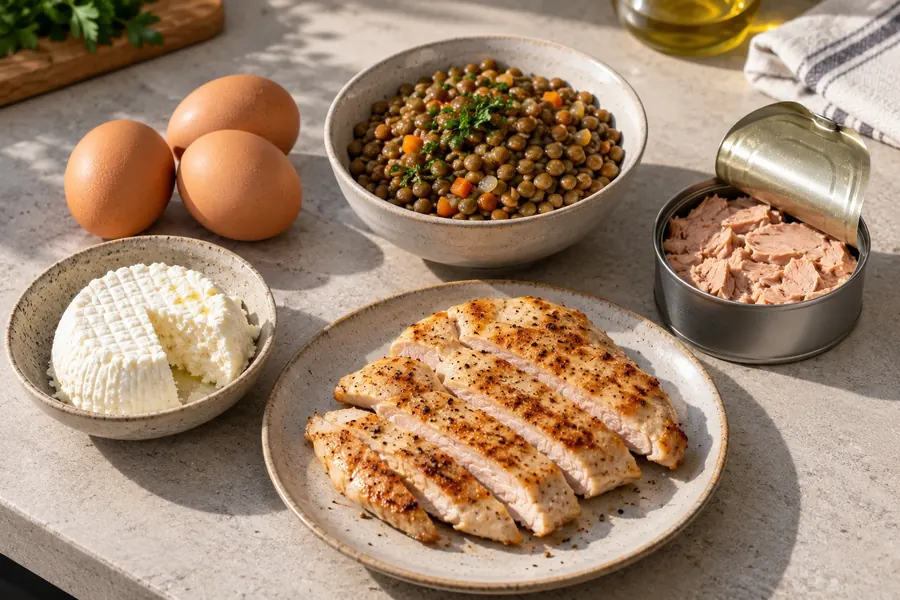
BCAA stands for branched-chain amino acids: leucine, isoleucine and valine. They are 3 of the 9 essential amino acids, the ones your body cannot make and that have to come from food. They make up around 25% of the amino acids in foods with complete protein, such as meat, fish, eggs or milk 5.
Leucine is the most studied of the three: as well as being a building block for protein, it acts as a signal that switches on muscle protein synthesis 2.
Level of evidence by outcome
| Outcome | Evidence | What the data show |
|---|---|---|
| Less muscle soreness after exercise | Moderate | Less muscle pain between 24 and 96 hours in a meta-analysis of 18 trials. |
| Markers of muscle damage | Low | Creatine kinase fell only at some time points; LDH, at none. |
| Muscle protein synthesis | Low | It rises with BCAAs alone, but less than with complete protein. |
| Muscle mass and strength | Preliminary | Some short studies with 10-14 g a day; results not very consistent. |
The rating is our own, based on the number of studies, their quality and the consistency of the results.
The key studies
| Study | Type | Sample | Outcome |
|---|---|---|---|
| Salem et al., 2024 | Meta-analysis | 18 trials | Less muscle soreness at 24, 48, 72 and 96 hours. Lower creatine kinase right after exercise and at 72 hours; no effect on LDH. 1 |
| Jackman et al., 2017 | Placebo-controlled trial | 10 trained men | 5.6 g of BCAAs after strength training: myofibrillar protein synthesis 22% higher than with placebo. Lower than in studies with whey protein. 2 |
| Wolfe, 2017 | Review | Human studies | To sustain an increase in muscle protein synthesis, BCAAs need the rest of the essential amino acids. 3 |
| Jäger et al. (ISSN), 2017 | Position stand | International Society of Sports Nutrition | 20-40 g of protein per serving, with 700-3,000 mg of leucine and all the essential amino acids. 4 |
| NIH, Office of Dietary Supplements | Review | Studies in athletes | Little evidence for endurance; inconsistent results for muscle and recovery. Up to 20 g a day, no safety problems in studies lasting up to 6 weeks. 5 |
What has been studied
Studies on BCAAs have focused on four areas: muscle mass, recovery from fatigue, perceived exertion and cognitive function after exercise 6. For muscle, the foundation is complete protein, and there the EU authorises this claim: “Protein contributes to a growth in muscle mass.” 7 A varied and balanced diet and a healthy lifestyle are important.
Muscle soreness: 18 trials
A meta-analysis of 18 trials found that BCAAs reduced muscle soreness at 24, 48, 72 and 96 hours after exercise that damages the muscle, although not straight afterwards. Creatine kinase, a marker of muscle damage, fell right after exercise and at 72 hours, but not at the other time points, and LDH did not change 1.
Muscle protein synthesis
BCAAs alone or complete protein
Protein synthesis: yes, to a lesser degree
In a trial with 10 trained men, taking 5.6 g of BCAAs after strength training increased myofibrillar protein synthesis by 22% compared with placebo 2. The response was smaller than in other studies with complete whey protein; that is why, for building muscle, the authors put complete protein first 2.
The explanation: making muscle takes all 9 essential amino acids, not just 3. A review concluded that, to sustain an increase in muscle protein synthesis, BCAAs need the rest of the essential amino acids 3. That is why the International Society of Sports Nutrition recommends servings of 20-40 g of protein with 700-3,000 mg of leucine and all the essential amino acids 4.
Performance
For endurance, research is still ongoing and data are still limited. Some short studies, of 3 to 6 weeks, with 10-14 g a day suggest more muscle mass and strength; overall, results still vary from one study to another 5.
Daily BCAA intake
How much has been studied without problems
Safety
- BCAAs: up to 20 g a day, split into several servings, has shown no safety problems in studies lasting up to 6 weeks 5.
- Leucine: a safe limit of about 500 mg per kg of body weight a day has been proposed, about 38 g for a person weighing 75 kg 5.
- If you have a health condition or take medication, check with your doctor.
Frequently asked questions
What are BCAAs good for?
In a meta-analysis of 18 trials they reduced muscle soreness between 24 and 96 hours after exercise. For muscle protein synthesis, studies see a greater effect with a complete protein, which provides all 9 essential amino acids.
What is leucine?
It is one of the three branched-chain amino acids and the most studied: it acts as a signal that switches on muscle protein synthesis. The International Society of Sports Nutrition suggests protein servings with 700-3,000 mg of leucine.
How many BCAAs should you take?
Very different doses have been used in studies. According to the US NIH, up to 20 g a day split into several servings has shown no safety problems in studies lasting up to 6 weeks.
Do BCAAs replace protein?
No. They are 3 of the 9 essential amino acids. If you already reach your daily protein with food or shakes, you are already getting BCAAs: they make up around a quarter of the amino acids in animal protein.
Sources
- Salem A, Ben Maaoui K, Jahrami H, et al. Attenuating muscle damage biomarkers and muscle soreness after an exercise-induced muscle damage with branched-chain amino acid (BCAA) supplementation: a systematic review and meta-analysis with meta-regression. Sports Med Open. 2024;10:42. View publication
- Jackman SR, Witard OC, Philp A, Wallis GA, Baar K, Tipton KD. Branched-chain amino acid ingestion stimulates muscle myofibrillar protein synthesis following resistance exercise in humans. Front Physiol. 2017;8:390. View publication
- Wolfe RR. Branched-chain amino acids and muscle protein synthesis in humans: myth or reality? J Int Soc Sports Nutr. 2017;14:30. View publication
- Jäger R, Kerksick CM, Campbell BI, et al. International Society of Sports Nutrition position stand: protein and exercise. J Int Soc Sports Nutr. 2017;14:20. View publication
- Office of Dietary Supplements, National Institutes of Health. Dietary supplements for exercise and athletic performance: fact sheet for health professionals. View publication
- EFSA Panel on Dietetic Products, Nutrition and Allergies (NDA). Scientific opinion on the substantiation of health claims related to branched-chain amino acids (BCAA). EFSA Journal. 2010;8(10):1790. View publication
- Commission Regulation (EU) No 432/2012 establishing a list of permitted health claims made on foods. View publication
Information based on published studies. It does not replace the advice of a doctor or registered dietitian. The results describe what was measured in each study, not the properties of any specific product.
