
In 30 seconds
- The next edition is on Sunday 14 February 2027 at 8.30 am, with water and isotonic drink at km 5, 10, 15 and 17.5, and gels at km 15.
- Drink to thirst: as a guide, 0.4-0.8 litres per hour, without drinking more than 80% of what you sweat or gaining weight.
- If you will take more than an hour and a half, choose a drink with 400-1,100 mg of sodium per litre and add 30-60 g of carbohydrates per hour.
- February is cool in Barcelona: an average of 9.9 °C at the airport, with a low of 5.4 °C and a high of 14.3 °C.
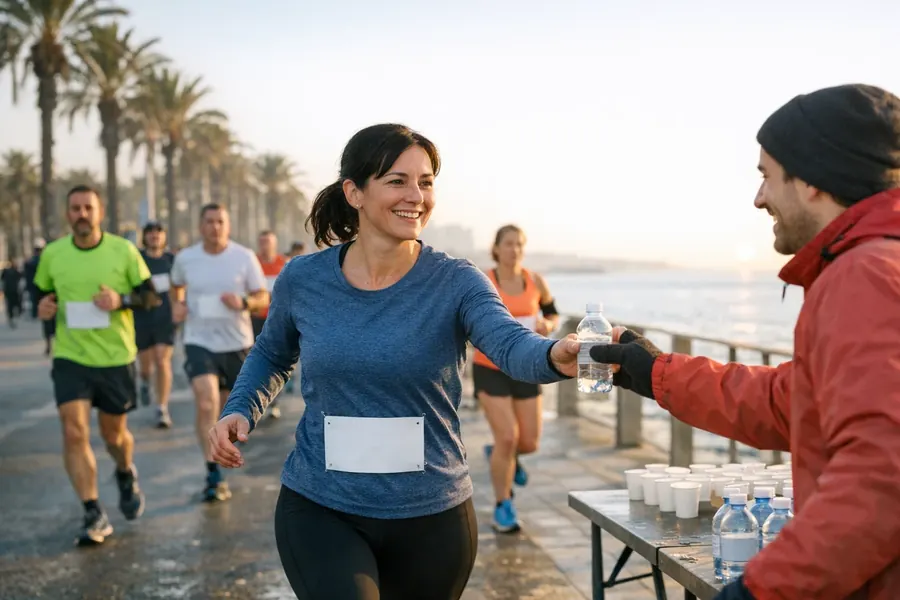
At the Barcelona Half Marathon, drink to thirst and, if you will take more than an hour and a half, choose a drink with 400-1,100 mg of sodium per litre and add 30-60 g of carbohydrates per hour 7 6. You will find water and isotonic drink at km 5, 10, 15 and 17.5, and gels at km 15 1 2.
At Nutri Gains we are a company from Girona. Here are the race's official details and what the evidence says, so that you reach the start line with a tested plan.
The race in numbers
The Barcelona Half Marathon in three numbers
The race at a glance
The next edition of the Mitja Marató Barcelona, the official name of the Barcelona Half Marathon, is on Sunday 14 February 2027, starting at 8.30 am 1 from Passeig de Picasso 3. There are pacers for 10 target times, from 1 h 20 min to 2 h 05 min, in the start pens for those times 2.
| Barcelona Half Marathon | |
|---|---|
| Date | Sunday 14 February 2027 |
| Start | 8.30 am from Passeig de Picasso, in start pens by target time |
| Distance | 21.097 km, entirely through the city, certified by the FCA, the RFEA and World Athletics |
| Time limit | 2 h 45 min from when the last runner starts |
| Elevation gain | 71 m over the whole course: 37 m in the first 10 km and 34 m in the rest (official 2026 map) |
| Aid stations | Drinks at approximately km 5, 10, 15 and 17.5, plus drinks and food at the finish |
| February temperature | 9.9 °C on average, with lows of 5.4 °C and highs of 14.3 °C |
Sources: official race rules, course, FAQs and map; AEMET, Spain's state meteorological agency, 1981-2010 normals at Barcelona airport.
It is 21.097 km through the city, certified by the Catalan Athletics Federation (FCA), the Royal Spanish Athletics Federation (RFEA) and World Athletics, with a time limit of 2 h 45 min 1. According to the official 2026 map, the course has 71 m of elevation gain in total 4.
February in Barcelona: cool and fairly flat
At Barcelona airport, February has an average temperature of 9.9 °C, with lows of 5.4 °C, highs of 14.3 °C and 70% relative humidity 5. With an 8.30 am start, you will be running in the cool of the morning.
But every body sweats differently. Sweat rate ranges from 0.3 to 2.5 litres per hour, depending on intensity, weather and the individual 7. To find out yours, weigh yourself before and after a long run and use our hydration calculator. And for your race-day plan, the race hydration planner already has the Barcelona Half Marathon loaded.
Duration matters too. Endurance efforts of up to 60 minutes can be done without drinking; beyond 60 minutes, it is a good idea to drink during the activity 7.
Before: the day before and breakfast
- Carbohydrate loading (10-12 g per kilo per day for the 36-48 hours beforehand) is the guideline for events lasting more than 90 minutes 6. If you will take more than an hour and a half, it may be worth it; if not, your usual meals are enough.
- Breakfast: 1-4 g of carbohydrates per kilo, 1 to 4 hours before 6. With an 8.30 am start, that means between 4.30 am and 7.30 am.
- Fluid: 5-10 ml per kilo in the 2-4 hours beforehand, until your urine is pale yellow 7. If you weigh 70 kg, 350-700 ml.
- Do not overdo it: drinking too much water beforehand makes you urinate more and can lower your blood sodium 7.
You will find the full plan in our sports hydration guide.
By target time
What to drink during the race, depending on how long you will take
During: 4 aid stations
Every aid station has water and isotonic drink in cups, medical services and toilets. The one at km 15 also has gels 2.
| Aid station | What is there | At 5 min/km | At 6 min/km |
|---|---|---|---|
| Km 5 | Water and isotonic drink, in cups | Minute 25 | Minute 30 |
| Km 10 | Water and isotonic drink, in cups | Minute 50 | 1 h |
| Km 15 | Water, isotonic drink and gels | 1 h 15 min | 1 h 30 min |
| Km 17.5 | Water and isotonic drink, in cups | 1 h 27 min | 1 h 45 min |
| Finish | Drinks and food | 1 h 45 min | 2 h 07 min |
Based on the race rules and FAQs. Approximate split times at an even pace. Check the points on the official website before the race.
How to use them:
- Fluid: drink to thirst. As a guide, 0.4-0.8 litres per hour during hard efforts, without drinking more than 80% of what you sweat or gaining weight 7.
- Sodium: in activities lasting more than an hour and a half, drinks with carbohydrates and sodium, containing 400-1,100 mg of sodium per litre 7.
- Carbohydrates: for efforts of 45-75 minutes, small amounts or even a mouth rinse; from 1 to 2.5 hours, 30-60 g per hour 6.
If you will take about 2 hours, spread your carbohydrates out: the isotonic drink at km 5 and 10 (or your own gel) and the official gel at km 15. If you have never tried it, bring your own. On race day, nothing new.
If you are also running the Barcelona Marathon in March, use the half as a rehearsal. You will find the marathon plan, aid station by aid station, in Barcelona Marathon hydration.
Be careful not to drink too much
The international consensus on hyponatraemia, a fall in blood sodium, identifies its main cause as drinking more fluid than you lose 8. The risk factors: gaining weight during the race, running at a slow pace and always having drinks to hand 8.
Over the marathon distance and shorter ones, most events record no cases with symptoms 8. Even so, the rule is the same: drink to thirst, isotonic drink included. Sports drinks do not prevent hyponatraemia if you drink more than you sweat 8. We explain it in drinking too much water during exercise.
After the finish
- Weigh yourself: the weight you have lost is mostly fluid.
- If you have lost less than 5% of your body weight and you are not training in the next 24 hours, your usual meals, a snack and water are enough 7.
- If you want to recover quickly, replace 1.25 to 1.5 litres for every kilo lost 6, in sips and ideally with electrolytes and with food 7.
You will find the step-by-step guide in how to rehydrate after training.
With Nitrus Isotonic
Each 25 g scoop of Nitrus Isotonic in 400-500 ml of water provides about 195 mg of sodium and 15 g of carbohydrates, with 5 electrolytes and all 13 vitamins. Depending on how much water you use:
| Preparation | Sodium per serving | Sodium per litre | Carbohydrates per serving | Carbohydrates per litre |
|---|---|---|---|---|
| 25 g in 400 ml | 195 mg | 488 mg | 15.1 g | 37.8 g |
| 25 g in 500 ml | 195 mg | 390 mg | 15.1 g | 30.3 g |
Each 25 g serving contains 0.488 g of salt (about 195 mg of sodium), 148 mg of potassium and 15.13 g of carbohydrates.
- On your long training runs: in 400 ml it comes to 488 mg of sodium per litre, within the reference range 7.
- On race morning: one scoop in 400-500 ml counts towards the 350-700 ml you drink beforehand.
- When you finish: it helps you replace fluid and sodium, in sips.
To reach 30-60 g of carbohydrates per hour, add gels or fruit: one bottle of Nitrus provides 15 g. Riboflavin (vitamin B2), vitamins B6, B12 and C, niacin, pantothenic acid and folate contribute to the reduction of tiredness and fatigue. A varied and balanced diet and a healthy lifestyle are important.
It costs €19.90, contains 20 servings and is caffeine-free. Born in Girona and made in Spain with IFS Food and BRCGS Food Safety certification.
Frequently asked questions
When is the Barcelona Half Marathon 2027?
On Sunday 14 February 2027. The start is at 8.30 am from Passeig de Picasso, and the time limit is 2 h 45 min.
How many aid stations does the Barcelona Half Marathon have?
There are drinks stations at approximately km 5, 10, 15 and 17.5, and one with drinks and food at the finish. According to the official website, there is water and isotonic drink in cups, and gels at km 15.
What should you drink in a half marathon?
Drink to thirst; as a guide, 0.4-0.8 litres per hour. If you will take more than an hour and a half, a drink with carbohydrates and 400-1,100 mg of sodium per litre is the better choice.
Do you need gels in the Barcelona Half Marathon?
If you will take between 1 and 2.5 hours, the guideline is 30-60 g of carbohydrates per hour, from isotonic drink, gels or fruit. For efforts of 45-75 minutes, small amounts or a mouth rinse are enough.
How hilly is the Barcelona Half Marathon?
According to the official 2026 course map, it has 71 m of elevation gain in total: 37 m in the first 10 km and 34 m in the rest.
Sources
- Mitja Marató Barcelona. Rules for the 2027 edition (articles 1, 2, 3 and 15). View publication
- Mitja Marató Barcelona. FAQ: aid stations and start pens. View publication
- Mitja Marató Barcelona. Course. View publication
- Mitja Marató Barcelona. Course map (2026 edition). View publication
- Agencia Estatal de Meteorología (AEMET). Valores climatológicos normales 1981-2010: Barcelona Aeropuerto. View publication
- Thomas DT, Erdman KA, Burke LM. Position of the Academy of Nutrition and Dietetics, Dietitians of Canada, and the American College of Sports Medicine: nutrition and athletic performance. J Acad Nutr Diet. 2016;116(3):501-528. View publication
- Mosler S, Braun H, Carlsohn A, et al. Position of the working group sports nutrition of the German Nutrition Society (DGE): fluid replacement in sports. Dtsch Z Sportmed. 2020;71(7-9):178-184. View publication
- Hew-Butler T, Rosner MH, Fowkes-Godek S, et al. Statement of the 3rd International Exercise-Associated Hyponatremia Consensus Development Conference, Carlsbad, California, 2015. Br J Sports Med. 2015;49(22):1432-1446. View publication
Information based on published studies. It does not replace the advice of a doctor or registered dietitian. The results describe what was measured in each study, not the properties of any specific product.
