
In 30 seconds
- Spending 5 minutes writing a to-do list before bed helped people fall asleep in about 15 minutes, compared with about 25 without it.
- In 12 trials with 785 adults, breathing techniques reduced perceived stress.
- In 18 trials with 1,654 people, mindfulness improved sleep quality compared with control activities.
- In a 4-week trial with 30 adults, L-theanine before bed improved the time taken to fall asleep and sleep disturbances compared with placebo.
When you are stressed, your mind keeps working at bedtime. What helps most is closing the day before you get into bed: putting what is still pending in writing, slowing down with your breathing and repeating a routine that helps you switch off. All of this has studies behind it.
Why stress keeps you awake
Researchers use the term “sleep reactivity” for how much stress disrupts your rest. For some people, a bad week barely changes their sleep; others take much longer to fall asleep or wake up more often 1.
Genetics play a part, as do having relatives who sleep badly, being a woman and stress in your surroundings. Behind it all are the autonomic nervous system and the cortisol axis, which regulates the stress response 1.
And there is an amplifier: worries and going over things in your head, which take advantage of that sensitive system and make the effect worse 1.
The good news is that this sensitivity can be detected. The authors suggest identifying people whose sleep is more reactive so that it can be looked after before the problem sets in 1.
How do you know if this applies to you? Two clues: in weeks of greater pressure you take much longer to fall asleep, or you wake up in the early hours thinking about what is pending.
If you exercise, it affects you in the same way. The expert consensus on sleep in athletes places stress and anxiety among the non-sporting factors that most influence how they sleep 2. And sport itself adds to it: training, travel and competitions also show up in sleep 2. If it happens to you the night before an event, here is how to sleep well before a race.
Writing before bed
A to-do list or a list of what you have already done
6 ways to switch off before bed
1. Write tomorrow's list
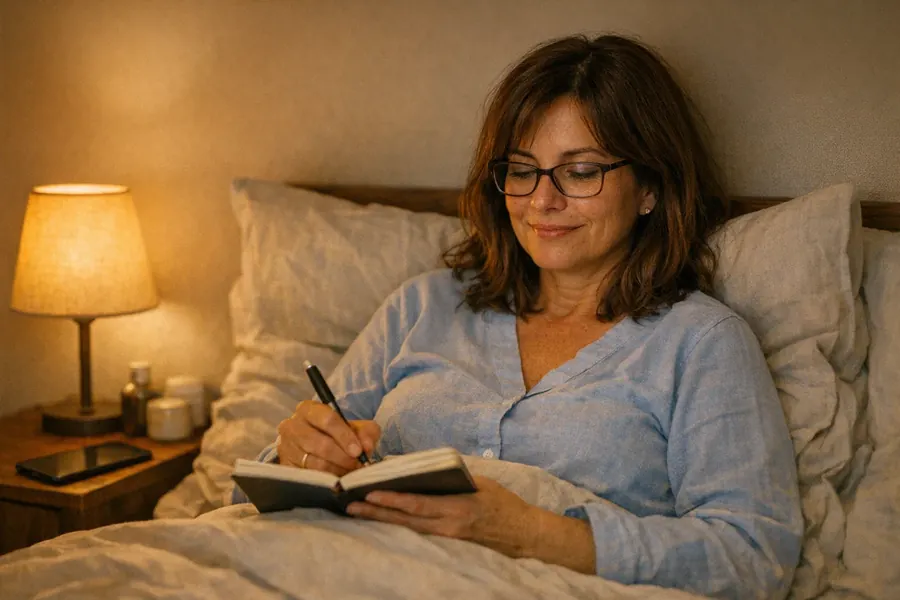
It is simple and it has been measured in the laboratory. 57 young adults spent 5 minutes writing before going to sleep. Some noted down their pending tasks for the next few days; others, what they had already done 3.
Those who wrote the to-do list fell asleep in about 15 minutes; the others, in about 25. And the more specific and complete the list, the sooner they fell asleep 3.
In practice: a notebook on your bedside table, five minutes and specific tasks. “Call Juan at 10:00” is better than “work”. Once what is pending is on paper, you do not need to go over it in bed.
2. Breathe more slowly
A meta-analysis of 12 trials with 785 adults found that breathing techniques reduce perceived stress, with a small to moderate effect 4.
The same analyses found a similar effect on symptoms of anxiety and low mood 4.
Try a few minutes of slow, calm breathing once you are in bed, with the lights off.
3. Try mindfulness
In 18 trials with 1,654 people, mindfulness meditation improved sleep quality compared with control activities involving the same time and attention. The effect was still there at follow-up 5.
You can start with a guided recording before bed.
4. Keep the bed for sleeping
Use your bed only for sleep and sex, and do not go to bed until you feel sleepy. If you have not fallen asleep after 20 minutes, get up and do something calm, in low light and without screens, and go back when you feel sleepy 6.
The idea is that the bed is for sleeping, not for going over your day. If it happens to you in the early hours, we explain what to do in why you wake up at night.
5. Switch off screens half an hour before
The recommendation is to switch off your phone, tablet and computer at least 30 minutes before going to bed 6. Work emails can wait until tomorrow.
6. Support for your bedtime routine
L-theanine is the characteristic amino acid in tea. In a trial with 30 adults with an average age of about 48, taking it before bed for 4 weeks reduced baseline anxiety compared with the start. Compared with placebo, it improved the time taken to fall asleep and sleep disturbances 7.
You will find all the data in L-theanine and tryptophan: what the studies say.
Where to start
You do not need to do it all on the first day
Your routine to switch off
Putting it all together, a typical evening looks like this:
| Time | What to do |
|---|---|
| 22:30 | Screens away and lights low |
| 22:35 | 5 minutes: tomorrow's to-do list, as specific as possible |
| 22:40 | Reading on paper or a guided mindfulness recording |
| 23:00 | Into bed, with a few minutes of slow breathing |
| If you are still awake after 20 minutes | Get up and do something calm, in low light and without screens |
Example routine using the techniques in this article. Sources: American Academy of Sleep Medicine and Scullin et al., 2018.
You do not need to do it all on the first day. Start with the list and the screens, and add the rest. You will find more habits in how to sleep better.
When to ask for help
If stress keeps you awake almost every night for weeks, or you feel anxious or low, talk to your doctor.
And if you want to know whether you are getting the rest you need, take our sleep test.
Frequently asked questions
Why can't I sleep when I am stressed?
Stress activates the nervous system and the cortisol axis, and worries keep going round in your head just when you need to switch off. It affects some people much more than others: specialists call this sleep reactivity.
What should I do if I get into bed and cannot stop going over everything?
If you are still awake after 20 minutes, get up and do something calm, in low light and without screens. Before bed, try spending 5 minutes writing tomorrow's to-do list.
Does writing before bed help you fall asleep sooner?
In a laboratory study, people who wrote their to-do list fell asleep in about 15 minutes, compared with about 25 for those who wrote about what they had already done. The more specific the list, the sooner they fell asleep.
Does meditation help you sleep?
A meta-analysis of 18 trials with 1,654 people found that mindfulness meditation improved sleep quality compared with control activities, and the effect was still there at follow-up.
Sources
- Kalmbach DA, Anderson JR, Drake CL. The impact of stress on sleep: pathogenic sleep reactivity as a vulnerability to insomnia and circadian disorders. J Sleep Res. 2018;27(6):e12710. View publication
- Walsh NP, Halson SL, Sargent C, et al. Sleep and the athlete: narrative review and 2021 expert consensus recommendations. Br J Sports Med. 2021;55(7):356-368. View publication
- Scullin MK, Krueger ML, Ballard HK, Pruett N, Bliwise DL. The effects of bedtime writing on difficulty falling asleep: a polysomnographic study comparing to-do lists and completed activity lists. J Exp Psychol Gen. 2018;147(1):139-146. View publication
- Fincham G, Strauss C, Montero-Marin J, Cavanagh K. Effect of breathwork on stress and mental health: a meta-analysis of randomised-controlled trials. Sci Rep. 2023;13:432. View publication
- Rusch HL, Rosario M, Levison LM, et al. The effect of mindfulness meditation on sleep quality: a systematic review and meta-analysis of randomized controlled trials. Ann N Y Acad Sci. 2019;1445(1):5-16. View publication
- American Academy of Sleep Medicine. Healthy sleep habits. Sleep Education. View publication
- Hidese S, Ogawa S, Ota M, et al. Effects of L-theanine administration on stress-related symptoms and cognitive functions in healthy adults: a randomized controlled trial. Nutrients. 2019;11(10):2362. View publication
Information based on published studies. It does not replace the advice of a doctor or registered dietitian. The results describe what was measured in each study, not the properties of any specific product. A varied and balanced diet and a healthy lifestyle are important.
