
In 30 seconds
- Today the main factor is thought to be fatigue of the muscle and of its nervous control; dehydration and salt loss count for much less.
- When cramp strikes, the quickest and safest thing is to stretch the muscle gently until it passes.
- To prevent them: train at the intensity and in the conditions of your event, build strength and rest well.
- Hydrating well is still important, but trying to replace all your salts with drinks alone can be dangerous.
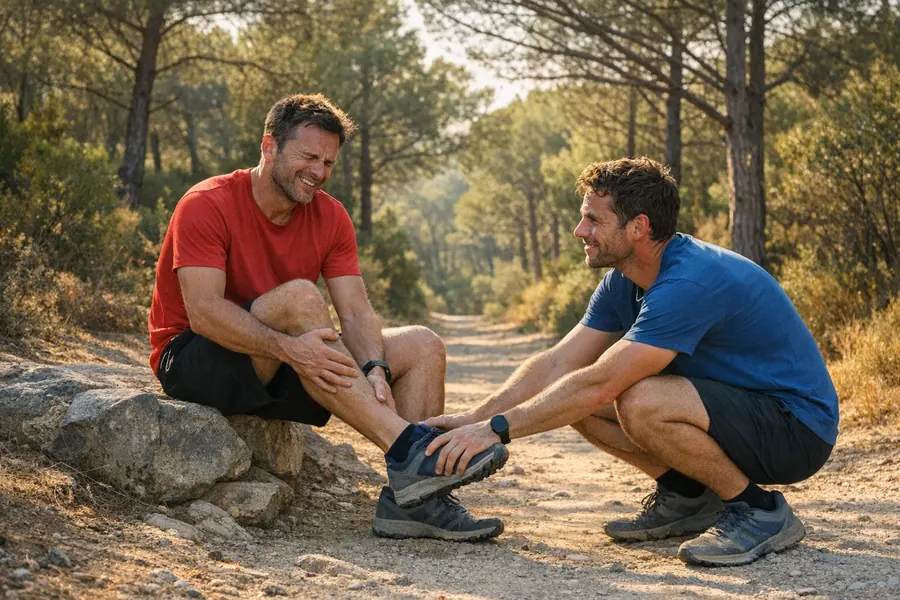
You are at kilometre 30, or on your last set, and your calf locks up. Cramp is one of the most common problems in sport, and also one of the most poorly explained. This is what the most comprehensive review to date says 1.
Two explanations
Why you get cramp when you exercise
Why they happen: two explanations
For decades, dehydration and a lack of salts were blamed. Today another explanation has more support: fatigue of the muscle and of the nerves that control it, which upsets the balance of the signals that make it contract and relax 1.
| Theory | For | Against |
|---|---|---|
| Dehydration and salt loss | American football players who lost a lot of sodium in their sweat had around 9 times the risk. In a sauna, 3 of 9 men got cramp after losing 2-3% of their body weight. | Blood tests are usually the same with and without cramps. Stretching stops them without any change in fluids or salts. In another study, losing 3-5% of body weight did not change how easily they could be triggered. |
| Neuromuscular fatigue | They are associated with lower fitness and higher intensity. They can be triggered without being dehydrated. | Highly trained athletes get them too. |
Source: Miller et al., 2022.
The authors' conclusion: what matters most is neuromuscular excitability, and dehydration and salt loss much less so. Several factors probably add up until they cross a threshold, which is different for each person 1.
If cramp strikes
What to do when cramp strikes
What to do when cramp strikes
- Stretch the muscle gently and hold the stretch until it passes. It is the quickest, safest and most effective option 1.
- Rest for a little while before carrying on.
- Drink something with carbohydrates and electrolytes if it agrees with you 1.
On the popular remedies 1:
- Magnesium: a Cochrane review found no clinical benefit over placebo.
- Pickle juice: in a small study, less than 100 ml stopped cramp about 49 seconds sooner than water. It does not seem to be down to the salts, but to a reflex triggered by the vinegar.
- Quinine: it should not be used for exercise-associated cramps.
Who is most at risk
Several studies have followed athletes in competition and compared those who got cramp with those who did not:
| Study | What made the difference | What did not |
|---|---|---|
| Ironman: 210 triathletes, 43 with cramps | Going faster and having had cramps in any of their last 10 races | Weight loss and salt levels in the blood |
| Marathon: 88 runners at the finish, 20 with cramps | More signs of muscle damage, at the finish and the next day | Weight loss and sodium and potassium levels in the blood |
| American football: 5 players with frequent cramps and 5 without | Their sweat contained more than twice as much sodium: about 1,255 mg per litre versus 582 | How much they sweated was similar |
Sources: Schwellnus et al., 2011; Martínez-Navarro et al., 2022; Stofan et al., 2005.
Two things keep coming up. The first: having had cramps before and pushing harder than usual count for more than dehydration. In the Ironman, neither weight loss nor salt levels in the blood separated the two groups 2, and nor did they in the marathon 3.
The second: tired or damaged muscle. The marathon runners with cramps had more markers of muscle damage in their blood, right at the finish and the next day. What is more, only 25% of them did strength work, compared with 47.6% of those who did not get cramp, although that difference was not conclusive 3. It fits with the neuromuscular fatigue explanation and with the advice to build strength that you will see below.
There is one special case: people whose sweat is very salty. In a small study of American football players, those who often got cramp lost more than twice as much sodium in their sweat as their teammates 4. We look at this a little further down.
How to lower the risk
- Train the way you compete: at the intensity, duration and heat of your event, so your muscles arrive prepared 1.
- Build strength: strength work, plyometrics or neuromuscular retraining are recommended when fatigue is the factor 1.
- Rest between hard sessions.
- Hydrate sensibly: drink to thirst and replace sodium in long sessions. But do not try to replace all the salts you lose with drinks alone: the authors warn that this can be dangerous because of the risk of hyponatraemia 1.
- Stretching beforehand does not seem to prevent them 1.
If you get them often, talk to your doctor: the review recommends looking for each person's own factors, because general advice works less well 1.
If your sweat is very salty
The amount of salt you lose in sweat varies enormously from one person to another. In a marathon in Spain, one in five runners (19.7%) had very salty sweat 6. You will find it explained in detail in how much salt you lose when you sweat.
Does it play a part in cramps? The clearest link is an old one: in studies from the 1920s and 1930s with industrial workers exposed to intense heat, adding salt to their drinking water greatly reduced cramps. In athletes the data are scarcer and more contradictory, and the review concludes that no strategy works in every case: there are probably cramps with different origins 5.
If your sweat is very salty and your cramps come on in long or hot sessions, it makes sense to pay attention to the sodium in what you drink while you exercise. But bear in mind what we said earlier: drink to thirst and do not try to replace it all with drinks alone 1.
Hydration: drink well in long sessions
Drinking well in long sessions is still important for your performance and your health, even if it is not the main cause of cramps. Work out how much fluid and sodium you lose with our hydration calculator, and you will find all the details in the sports hydration guide.
Our Nitrus Isotonic provides carbohydrates, five electrolytes and all 13 vitamins for your long sessions.
Frequently asked questions
Are cramps caused by a lack of salts?
That is not the main factor. The fullest review concludes that fatigue of the muscle and its nervous control matters most, and dehydration and salt loss much less so.
What should I do if I get cramp?
Stretch the muscle gently until it passes: it is the quickest, safest and most effective option. Then rest. You can have a drink with carbohydrates and electrolytes if it agrees with you.
Does magnesium stop cramps?
A Cochrane review found no clinical benefit of magnesium over placebo for cramps.
Does pickle juice work?
In a small study, less than 100 ml stopped cramp about 49 seconds sooner than water. It does not seem to be down to the salts: it is thought to be a reflex triggered by the vinegar in the mouth.
Who is most at risk of cramps?
In the studies of triathletes and marathon runners, those who had had cramps before and those who were going faster than usual. The marathon runners with cramps also had more signs of muscle damage. Dehydration and salt levels in the blood did not make the difference.
Does taking salt help with cramps?
It can help people whose sweat is very salty, in long efforts and in the heat, but no strategy works in every case. And do not try to replace it all by drinking: drinking too much carries its own risks.
Sources
- Miller KC, McDermott BP, Yeargin SW, Fiol A, Schwellnus MP. An evidence-based review of the pathophysiology, treatment, and prevention of exercise-associated muscle cramps. J Athl Train. 2022;57(1):5-15. View publication
- Schwellnus MP, Drew N, Collins M. Increased running speed and previous cramps rather than dehydration or serum sodium changes predict exercise-associated muscle cramping: a prospective cohort study in 210 Ironman triathletes. Br J Sports Med. 2011;45(8):650-656. View publication
- Martínez-Navarro I, Montoya-Vieco A, Collado-Boira E, Hernando B, Panizo N, Hernando C. Muscle cramping in the marathon: dehydration and electrolyte depletion vs. muscle damage. J Strength Cond Res. 2022;36(6):1629-1635. View publication
- Stofan JR, Zachwieja JJ, Horswill CA, Murray R, Anderson SA, Eichner ER. Sweat and sodium losses in NCAA football players: a precursor to heat cramps? Int J Sport Nutr Exerc Metab. 2005;15(6):641-652. View publication
- Maughan RJ, Shirreffs SM. Muscle cramping during exercise: causes, solutions, and questions remaining. Sports Med. 2019;49(Suppl 2):115-124. View publication
- Lara B, Gallo-Salazar C, Puente C, et al. Interindividual variability in sweat electrolyte concentration in marathoners. J Int Soc Sports Nutr. 2016;13:31. View publication
Information based on published studies. It does not replace the advice of a doctor or registered dietitian. The results describe what was measured in each study, not the properties of any specific product. A varied and balanced diet and a healthy lifestyle are important.
